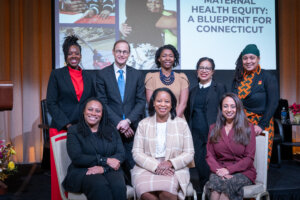
We were thrilled to host close to 150 people recently to mark the launch of the maternal health equity blueprint for Connecticut. The event brought together people from across the state who are working toward the vision of maternal health equity, and left us inspired to move this work forward in 2026 and beyond. 
The blueprint was the result of more than 18 months of work by experts from Yale, an advisory committee representing a wide range of sectors, and feedback from more than 200 residents. It focuses on reducing severe maternal morbidity – life-threatening complications can occur during or after pregnancy and birth.
While Connecticut typically ranks high in most health measures, our state was ranked 35th in the nation in severe maternal morbidity in 2021 (more recent data shows we fell to 37th). That data covers all state residents, but the burden of these complications does not fall evenly. Black Connecticut residents are twice as likely to experience severe maternal morbidity as their white peers.
Dr. Joia Crear-Perry, the keynote speaker and founder and president of the National Birth Equity Collaborative, noted that Connecticut’s statistics – low maternal mortality but high morbidity – indicate to her that the state’s health care system does a good job at treating medical crises, but that the state struggles to address the many things that can cause women to experience complications.
“If you’re number 35 for morbidity but then you save them, that means you’re really good at sick care, but you are not doing so great at prevention,” she said.

Dr. Joia Crear-Perry, founder and president of the National Birth Equity Collaborative
Crear-Perry spoke of the importance of examining policies and practices – ranging from Medicaid coverage to whether a health care facility has evening hours and how they treat patients who struggle to get to appointments because they don’t have childcare or reliable transportation.
“The policies that we make actually create health inequities,” she said.
Instead, she urged the audience to work to create new frameworks and policies based on human rights and the value of all people.
During a panel discussion, five members of the advisory committee that helped develop the blueprint spoke about the importance of changing policies and practices.
SciHonor Devotion, a midwife and doula and founder of Earth’s Natural Touch: Birth Care and Beyond, noted that policies can create disparities in outcomes, and urged everyone in the audience to reflect on their own organizations.
“Think about those policies that you have at your organizations and how they are impacting families in real life,” she said.
Dr. Iyanna Liles, an obstetrician-gynecologist and co-chair of the Connecticut Maternal Mortality Review Committee, spoke of trying to deliver the kind of care to her patients that she would want her family members to receive.
“These are your neighbors, your cousins, someone in your community,” she said. “I have people come to me crying just because I listened to them…and it’s because someone took the time to value them.”
Dr. Tabassum Firoz, an attending physician at Bridgeport Hospital and assistant clinical professor at Yale School of Medicine, described the importance of learning patients’ stories and understanding everything that shapes their health and lives.
“We need a broader approach to serving women, especially marginalized women like Black women, that is not just the medical perspective – their pre-eclampsia or gestational diabetes, but all the different things that influence those things that are just as important, if not more important,” she said.
Dr. Marcella Nunez-Smith, associate dean for health equity research at Yale School of Medicine, said she saw the blueprint as a way to “not just observe and admire the problem, but to actually intervene.” Nunez-Smith co-chaired the advisory committee and leads the Yale Equity Research and Innovation Center, which developed the blueprint with the Yale Global Health Leadership Initiative.
“As someone who has been lecturing medical students and other health professional students for decades, I want to be able to get the chance to give them a different kind of lecture when it comes to maternal health outcomes. I am tired of giving them the same statistics, the same graph, puzzling as to why we see these disparities persist in this way,” she said. 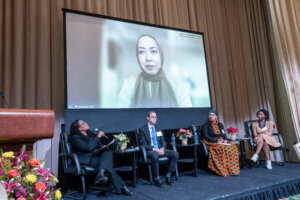
Nunez-Smith added that she hopes that in five years, she will be able to show different statistics to her students, and that patients and communities will experience a different reality.
Mark Schaefer, vice president of system innovation and financing at the Connecticut Hospital Association, called for the state to live up to its motto – “still revolutionary” – in taking on the critical public health priority of maternal health. He noted that the Connecticut Hospital Association has a maternal health strategy that includes focusing on root causes of maternal health outcomes including racism and economic inequality, and ensuring that people are heard and included in decisions about their maternal health care.
State health leaders described the role of the blueprint. Public Health Commissioner Dr. Manisha Juthani said her department is committed to seeing the blueprint through. Social Services Commissioner Andrea Barton Reeves described the state’s low ranking in severe maternal morbidity as a clarion call that something different needs to happen, and said the blueprint can change the trajectory. She noted that behind every statistic is a story.
State lawmakers also described the importance of addressing inequities in maternal health.
Connecticut Health Foundation President and CEO Tiffany Donelson expressed gratitude for the commitment of so many state residents to working toward a vision for all state residents to have the opportunity to have a safe and healthy pregnancy, birth, and start to parenthood. In the coming months, the Connecticut Health Foundation plans to work with those in the field to plan for implementation of the blueprint.